by Charles Plant | Jun 13, 2012 | Emotional Intelligence, Leaders
Gregg Saretsky gets a lot of press for his efforts to improve the performance of Canadian airline WestJet. What he should also get a lot of press about is his skill as a leader. I really liked a story about Gregg working a flight recently as a cabin attendant. he was obviously experienced in the role and comfortable joking with passengers and staff alike as the flight progressed.
Having worked his whole life in the airline industry, he can empathize with other staff and bring a much more personal touch to the role that someone who would never have worked in the industry. This degree of empathy that experience brings is essential, not only in the good times but particularly in bad ones as well.
An empathetic leader will still have to make the tough calls but employees are much more comforted and thus motivated even in bad times knowing that someone understands what their troubles might be, is sensitive to their needs and has their back.
by Charles Plant | Jun 12, 2012 | Leadership Development, Literature Review
 Research from the Center for Creative Leadership attempted to answer the question of whether leaders are born or made. You can read the research here. While 52% of the respondents believe that leaders are made, fully 19% believe that people are born leaders. A further 28% believe that they are both born and made.
I found it to be a very strange topic to research. If you look at the results, 48% of people would appear to believe that you need to be born with leadership capabilities to become a leader and of those, 19% think that no amount of training can help. I suppose that those who believe that you need to have some innate leadership capability would be those that support streaming of children in early grades or that an aristocracy is a better form of government than a meritocracy. The same discussion takes place all the time in the world of entrepreneurship wherein people attempt to pontificate about whether entrepreneurs are born or made.
It is a silly discussion as it doesn’t get us anywhere as a society. We need entrepreneurs and we need leaders. Every single person has some degree of entrepreneurial spirit and some degree of leadership capability. Leadership does not only happen at the CEO level or in politics. Each and every person needs to perform some act of leadership even if that is only providing a vision and motivating oneself to get through the day. Every person in a working environment who collaborates with others needs to perform small acts of leadership on a daily basis.
I’m hoping that the Center for Creative Leadership come out soon with a study about how many angels can dance on the head of a pin. Perhaps instead of arguing about whether leaders are born or made, we should be trying to figure out how to accelerate their growth as fully 81% seem to believe that this is possible..
by Charles Plant | Jun 8, 2012 | Emotional Intelligence
 I must first admit that I love Survivor. I have watched every single episode, almost all of them when originally aired. Now there are two types of people who like Survivor; really stupid ones and really smart ones. I’m not sure which I am. The reason I like it is that it is so close to the business world that the game becomes reality when looked at in a business context. Just as in business, you need to build a strategy, keep yourself positive, communicate well, build alliances and if you want to win you need to motivate people. These are essential leadership skills that come together in one person only once in a while. The last winner, from Survivor One World was Kim Spradlin, a 29 year old bridal shop owner from San Antonio.
I’ll do a number of posts about the show in upcoming weeks but this is the first. Kim was really special in terms of past winners as she had it all. She played the game flawlessly and deserves the million dollars. The first thing she had was skill.
You need some degree of skill
Survivor is partly an athletic game so you need some athletic abilities to make it to the end. You don’t have to be the best athlete but at some point in time you must prove yourself on the field of combat. Kim had the perfect set of athletic skills and in fact went on to win four individual challenges. She had competitors like Jay, Matt, Michael and Troy who probably had more athletic ability but in Survivor, that is usually a hinderance. The people with no athletic ability or outdoor skills get voted out first. The ones with very strong athletic skills typically make it to the merger of tribes because of what they offer to the tribe in winning contests. After the merge however, the game is individual and a strong competitor will likley be thought of as a threat and be voted out unless they are really good at getting along with others.
But it takes more than skill
So you’re probably wondering how this compares to business. Well, in business if you are very strong at a certain skill such as finance but weak at emotional intelligence, your career will rise and hit a ceiling at some point in time. You are milked for your skills but don’t make the top rung of the ladder in most situations. That’s why:
‘A’ students work for ‘B’ and ‘C’ students.
by Charles Plant | Jun 7, 2012 | Leadership Development, Video
Derek Fisher comes up with some great theories. (His last one in this blog was on his Convoy Theory.) In this video blog, Derek talks about why he delays making decisions until one really has to be made.
http://vimeo.com/43540276
by Charles Plant | Jun 5, 2012 | Leadership Development
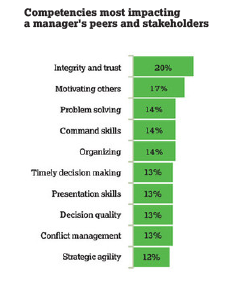
Last week this blog looked at a Futurestep survey and something it calls consequential impact which is essentially your ability to get things done through others. Another question the survey attempted to answer was what skills are necessary for you to have consequential impact on your peers. The answer for this was a tad surprising in that it concluded that for you to have peer impact, the most important thing was to have integrity and trust as well as be a good motivator. Once again, the soft skills triumped the hard skills in that getting things done through peers is still primarily done through leadership skills, not through problem solving, organizing , and good decision making.
by Charles Plant | Jun 4, 2012 | Emotional Intelligence, Exercises
Your ability to control unexpected emotions like anger and frustration and not display other negative emotions are hallmarks of Emotional Intelligence. (I must admit that I wasn’t always very good at this and I like to think that with age comes maturity.) The reason that you need to cure the habit and control negative emotions is probably self apparent.
Nobody wants to work with a Debbie-Downer.
After all, who wouldn’t prefer to work with someone who exhibited happiness over sadness, joy over grief, contentment over frustration. Emotions are contagious and if you’re stuck with a negative person, you’ll find your energy drained and begin avoiding their company.
The first step in curing this nasty habit is to be aware that you’re showing your negative emotions. While it isn’t easy to see these in yourself until after the fact, it is easier to see in people you are working with.
 Try this at work:
Your exercise this week is to pay attention to coworkers negative emotions. Take out your notebook and write down every time someone at work exhibits a negative emotion. That emotion could be anger, frustration, irritation, cynicism or whatever other negative emotion you detect. When you note this negativity, note how you feel as a result and how this mood affects those around you. If you keep noting this behaviour in others, you’ll come to notice it in yourself and that is the first step to stopping the habit.
When you have a chance, write a comment to tell me about what you observed and whether that made you question your own display of emotions.