Are you listening?
I asked Derek Fisher what he thought was the greatest skill he learned in being a manager and he said, listening. Surprisingly, his answer was repeated by several other people of whom I asked the same question.

I asked Derek Fisher what he thought was the greatest skill he learned in being a manager and he said, listening. Surprisingly, his answer was repeated by several other people of whom I asked the same question.
 It’s funny how something as simple as walking around chatting with people can become a style of management. Proponents of MBWA claim that:
Successful CEOs such as John Connelly of Crown Cork and Seal and Mike Duke of WalMart were famous for walking the shop floor and the loading docks, just chatting with employees. MBWA may have allowed them to uncover hidden problems but it was something more than that. It made them leaders.
MBWA is about making an emotional connection
If you want to be a great leader, you’ll need to make an emotional connection with people and MBWA is a great way of doing that.
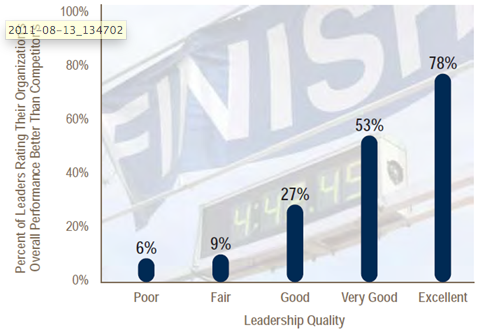
Well duh? Of course effective leadership matters. Did we need a study to tell us this? Actually, we probably did. For some reason, we are predisposed to give people positions of power and authority without any training in management and leadership. Development Dimensions International published their 2011 study on leadership. You can read a good blog summary of the findings here.
“The research demonstrated that organizations with the highest quality leaders were 13 times more likely to outperform their competition in key bottom-line metrics such as financial performance, quality of products and services, employee engagement, and customer satisfaction.”
If you think you might like to be a manager, listen to Kerri Golden’s video blog about something you might like to consider.
 When I was growing up, calling a person on the phone after 10:00 pm was just something you didn’t do. Nor did you butt ahead of people in line or call an elder by their first name without being explicitly invited to do so. There has always been some form of social contract governing individual behavior in society and people who flouted that social contract were to others, outcasts.
There has always been a social contract at work.
Just as there has always been a social contract between individuals and their government and in society, so too has there been one in work. Before the ICT Revolution, there were things that you just did not do in a working environment. There was a way that the corporation as represented by one’s manager behaved in relation to each and every employee. There were acceptable modes of behavior and unacceptable ones.
But for some reason, the social contract has been broken.
The net result of all of the change at work due to computerization is that the social contract that existed between workers and their employers has been broken. We need to either return to the old social contract and change our behavior or we need to develop a new social contract to recognize the impact that technological change is having on our lives. While firms have done an excellent job developing mission and value statements, they need to work to develop social contracts with employees and state these directly so that everyone can understand what is acceptable behavior and what is unacceptable.
I heard an interesting story from someone who was patient enough to listen to my mentorship for several years. One of the things that I had emphasized was that: Responsibility is taken, it is not given. The point of this blog though is not about what I had said but about how it had travelled. The individual I was mentoring told me how she had passed it on to someone who she was mentoring and this individual had passed it on to her husband who was then trying it himself at work. It proves the point that:
When you mentor someone the mentorship doesn’t just stop there.
Instead, if you have meaningful mentorships, the knowledge and experience is passed down through many people and hopefully for many years.
It takes a community to build a leader.