by Charles Plant | May 31, 2012 | Literature Review, Management
Some time ago I subscribed to Harvard Business Review (for the umpteenth time), just to get a collection of articles called Leadership Insights. The first in the collection is a reprint of Henry Mintzberg’s “The Manager’s Job”. If you haven’t read it recently, it is worth a re-read. Based on a review of research into how manager’s spend their time it debunks a lot of old folklore and although it was first written in 1975, is still applicable today.
What struck me the most was at the very end of the article. In it Mintzberg states that management schools have done”an admirable job of training the organization’s specialists – management scientists, marketing researchers, accountants, and organizational development specialists. But for the most part they have not trained managers.”
And Now Time For a Rant
It’s sad to think that 40 years after Mintzberg first published a book on this subject, we are still not doing a better job training managers. This training is still not happening in MBA programs for the most part and few companies are doing it well. A friend told me that she is studying for an exam to enable her to become a Certified Meeting Professional. If there is a course for meeting professionals, just as there is for Corporate Trainers, Project Managers, Aestheticians, and a host of other disciplnes, why is there no course or certification for managers, something that 10s of millions of people do worldwide?
by Charles Plant | May 30, 2012 | Emotional Intelligence, Leaders
 When you think of famous inventors, you often think of people working away in their labs, day after day, alone, producing failure after failure until they eventually succeed. Inventors are thus rightly known for their persistence. As a leadership skill, persistence is often underrated. When you think of Orville and Wilbur Wright, you would be right to credit them with persistence but not perhaps for the area in which they exhibited their greatest persistence, that of marketing their invention.
Innovation = Idea + Marketing
I’ve used this formula before in a blog and when most people think of persistence, they think in terms of coming up with a working idea. In actual fact, marketing can take much more persistence that inventing and Orville and Wilbur Wright are an excellent example of this. You might know that the Wrights made the first powered flight on December 17th 1903. In 1904, they set up an air strip in Dayton and flew every day but hardly any reporters came to see them.
With 105 flights under their belt, they wrote the US government to see if the army might be interested. The War Department responded that they were not interested in providing financial assitance until such a device could be “brought to the stage of practical operation without expense to the US government” which they had already done.
In October of 1905, the Wrights wrote the government again and by this time they had made flights of up to 39 minutes over 20 miles. The War department declined once again with the same comments and this so discouraged the Wrights that they basically ceased flying as the Wrights couldn’t see any use for airplanes other that for military purposes.
Persistence pays off
Finally, in 1907, an employee on the Army Signal Corps who was following the early flight pioneers convinced the government to give airplanes a try. The government acting very responsibly, put out a tender and got 41 bids. The Wrights finally won the tender and were able to make a sale to the US government. their persistence had paid off but it took almost 5 years from when they made their first flight until they got their first sale.
As a leader, are you persistent or do you give up too early?
by Charles Plant | May 29, 2012 | Management, Research
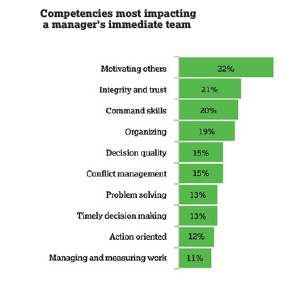
Back to the Futurestep survey I mentioned last week. This survey looked at something it calls consequential impact which is essentially your ability to get things done through others. Whether you manage people, projects, products or process, you’ll need to get things done through other people. The question the survey attempted to answer was what skills are necessary for you to have consequential impact on your own direct reports. No surprise here but your ability to motivate others and integrity and trust were the most important characteristics. As you move away from being an individual contributor to being a manager of people, such things as problem solving become less important than motivating your direct reports to solve the problems themselves.
by Charles Plant | May 25, 2012 | Research
 Research out of Columbia University summarized here suggests that men’s dominance of the ‘C’ Suite may not in fact be due to discrimination but to over confidence.
In an amusing set of studies, the researchers set out to determine whether men have an easier time ‘faking it’ due to natural overconfidence. The research shows that while both men and women exaggerate capabilities (aka, lie), men happen to over-report their results more than women. Not only do men exaggerate more than women, they tend to lie more the larger financial reward.
Thus you can see a board of directors faced with two candidates for the role of CEO, one a man, the other a woman, They both might have equal capabilities, but the man’s over-confidence and exaggeration of results compared to the woman is going to get him the job.
by Charles Plant | May 24, 2012 | Innovation, Learning
 Creative people don’t retire. They just keep on creating.
It’s probably because we love our work that we never want to stop. The question is: Do you love what you do enough to say the same thing? Do you love your work enough to never want to retire? And if you don’t then why not?
Why would you stay doing something that you didn’t absolutely love?
by Charles Plant | May 16, 2012 | Innovation, Management

Many companies are extolling the benefits of teleworking but to my mind, it’s just an excuse to save money. I don’t believe that you can innovate at a distance, form an effective team at a distance, or lead from a distance. certainly you can manage from a distance but leadership of people on a day to day basis requires an emotional connection.
While you might be able to maintain an emotional connection at a distance, I don’t see how you can create one. Without an emotional connection, you are only managing, not leading remote workers.
The point was driven home in a recent HBR article by Walter Isaacson on Steve Jobs. In the article, Jobs is quoted as saying ” There’s a temptation in our networked age to think that ideas can be developed by e-mail and iChat. That’s crazy. Creativity comes from spontaneous meetings, from random discussions. You run into someone, you ask what they’re doing, you say ‘Wow’ and soon you’re cooking up all sorts of ideas.”