Virginia Rometty – Self Confidence

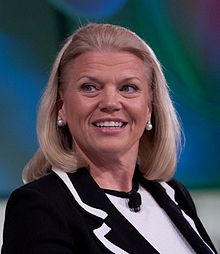
On January 1st, Virginia Rometty became IBM’s first female CEO.  She graduated as an engineer in 1979 and joined IBM in 1981 at a time when women were coming to enter the business world in droves. Along with the requisite skill, and emotional intelligence, one of the things that Rometty credits for her rise to the top is self confidence.

As reported in the New York Times: “The age group of women becoming C.E.O.’s started their careers in the early ’80s, when the huge tsunami of women were really building professional lives,” said Ilene H. Lang, chief executive of Catalyst, a research firm on women and business.”

“Yet the fact that Ms. Rometty’s gender remains newsworthy also exposes the lengths that businesses still need to go to before women who invest their careers in companies have a shot at the corner office, or even equal representation. Early in her career, Virginia M. Rometty, IBM’s next chief executive, was offered a big job, but she felt she did not have enough experience. So she told the recruiter she needed time to think about it.”

“That night, her husband asked her, “Do you think a man would have ever answered that question that way?” “What it taught me was you have to be very confident, even though you’re so self-critical inside about what it is you may or may not know, and that, to me, leads to taking risks.”

Self Confidence

“Confidence is a plant of slow growth in an aged bosom.”

William Pitt, Earl of Chatham, 1766

You probably don’t even notice it happening. Do you remember the first time you tried to dive off a very high diving board? Do you remember the feeling? The hesitation, the butterflies. Now do you remember the second dive off the same high diving board, the third, the tenth, the 100th? Your changed feelings are the result of building confidence.

One day, you face a new situation, full of dread, nervous anticipation and excitement. The next you are treating the situation as old hat, developing confidence with every step.

Self confidence is one of the keys to successful leadership.

Can you imagine following a nervous leader, one who lacks self confidence? It doesn’t work does it. So, if you want to be a good leader, you need to develop a well justified aura of self confidence. Developing it is all about practice. Doing something time and time again (eventually successfully) will build your self confidence.

 

Try this at work:

Find some small thing in which you feel that you lack self confidence. Don’t make it something huge like speaking to a group of 100 people if that is one of your fears. Make it something small, perhaps like having a conversation with someone who is very senior to you, saying no to an unreasonable request, meeting new people at a networking event, or voicing your opinion at a meeting.

Once you have picked this thing to work on, set yourself an objective of repeating the behaviour ten times. Yes that’s right, ten times.

Let’s say you want to become more self confident about speaking up in a meeting. The next time you go to a meeting, make it an objective to speak up sometime in the meeting to voice your opinion. Write down how you felt before voicing your opinion and how you felt after that. Note also what happenned. Did anyone hit you, yell at you, belittle you or did they just hear your opinion and move on? Now do that nine more times, writing down your feelings and the results of the experiment.

After you have completed the experiment ask your self, do you feel more self confident? Chances are you have developed a useful technique to overcome fears.

Jimmy Carter – The Micro-Manager as a Leader

No one wants a micro-manager as a leader so it’s surprising when one actually succeds in politics and in fact becomes President of the United States. Jimmy Carter was noted in his one term of President for being just such a micro-manager and it became one of the factors that limited him to just one term.

When Carter was elected President in 1976, he proved to be a masterful campaigner. Instead of courting the party establishment, Carter ran as an outsider, capitalizing on the post-Watergate mood of the nation. He quickly developed a reputation as a “policy wonk” and micromanager. A trained engineer, Carter was undoubtedly a keen micromanager, who desired to be involved at all levels of the decision-making process, and to be aware of all the details of every issue; he had an ‘inability to delegate.’

You get an early hint of his problems, for example, when he laments that he is inundated by piles of decision papers. Instead of reorganizing his staff, he decides to take an Evelyn Wood course in speed-reading.

He was faulted for lacking the grand vision of previous presidents, and for obsessing over the administrative details of the office at the expense of seeing the big picture. It was reported that Carter once took time to resolve a scheduling dispute between staffers over the use of the White House tennis courts.

Carter himself even said: “I was sometimes accused of ‘micromanaging’ the affairs of government and being excessively autocratic, and I must admit that my critics probably had a valid point.”

For some reason, people find it hard to see themselves as micro-managers and even when they do, to change their behaviour. Ask yourself, do you micromanage and if so, can you change this?


Authentic Leadership Development – A Research Study

Trust academics to study everything. You might have read last week’s rant on whether leaders are born or made. Sure enough, some very distinguished academics attempted to use research to figure this out.

Heritability and Leadership

To study whether leaders are born or made one group of researchers used identical and fraternal twins. “Preliminary evidence using a behavioral genetics approach has shown that approximately 30% of the variation in leadership style and emergence was accounted for by heritability; the remaining variation was attributed to differences in environmental factors such as individuals having different role models and early opportunities for leadership development (Arvey et al. 2007*).

Because identical twins have 100% of the same genetic makeup and fraternal twins share about 50%, this behavioral genetics research was able to control for heritability to examine how many leadership roles the twins emerged into over their respective careers. In this and subsequent research for both men and women across cultures, similar results were obtained. The authors conducting this research conclude that the “life context” one grows up in and later works in is much more important than heritability in predicting leadership emergence across one’s career.”

I’m glad that debate is done and we can turn to actually figuring out how to develop people as leaders instead of inventing tests to identify leadership capabilities at birth.

*Arvey RD, Zhang Z, Avolio BJ, Krueger RF. 2007. Developmental and genetic determinants of leadership role occu- pancy among women. J. Appl. Psychol. 92:693–706

The Eagle and the Jackdaw – Aesop on Leadership

An Eagle, flying down from his perch on a lofty rock, seized upon a lamb and carried him aloft in his talons. A Jackdaw, who witnessed the capture of the lamb, was stirred with envy and determined to emulate the strength and flight of the Eagle. He flew around with a great whir of his wings and settled upon a large ram, with the intention of carrying him off, but his claws became entangled in the ram’s fleece and he was not able to release himself, although he fluttered with his feathers as much as he could. The shepherd, seeing what had happened, ran up and caught him. He at once clipped the Jackdaw’s wings, and taking him home at night, gave him to his children. On their saying, “Father, what kind of bird is it?’ he replied, “To my certain knowledge he is a Daw; but he would like you to think an Eagle.”

The leadership lesson here: You must know your own strengths and limitations

And that’s not easy. We all like to think ourselves capable of miracles and deserving of increased responsibility until the point where we go one step beyond our capabilities.

Try this at work:

Your exercise this week is to actually take stock of your strengths and limitations. Write down a list of your 10 greatest strengths and your 10 most glaring weaknesses. When you have done this, talk to your boss or your mentor and get these confirmed. Look as well how these help or hinder in your current job and what the impact would be if you actually had your boss’ job.

When you have a chance, write a comment to tell me about what you observed.

Survivor Leadership Lesson 2 – Strategy

If you missed my first post about Survivor, you can read it here. Last week we talked about how you need a certain skill set to succeed in Survivor and in business. This week we’re looking at one of the keys to effective leadership, the ability to form strategies.

Without being able to form a strategy, any leader, whether it is of people, process, projects, products or whatever is doomed. Survivor is great at showing how people form strategies and  the really great part is that you can watch most of them fail. (No battle plan ever survives the first encounter with the enemy.)

Your strategy is your vision

Kim Spradlin had one of the most amazing strategies in Survivor history. She managed to create two very strong alliances, each with an entirely different group of people.  She was then able to control the entire game and the other side never knew. Few of the other players had a cogent vision and they thus became faithful followers. To ensure Kim’s vision succeeded, she quickly got rid of anyone who looked like they might be able to form a strategy.

This is just like being a leader at work. You need a cogent strategy and if you actually have one, you’ll find that other people around you won’t have well thought out ones of their own. They’ll fight to join onto your vision.